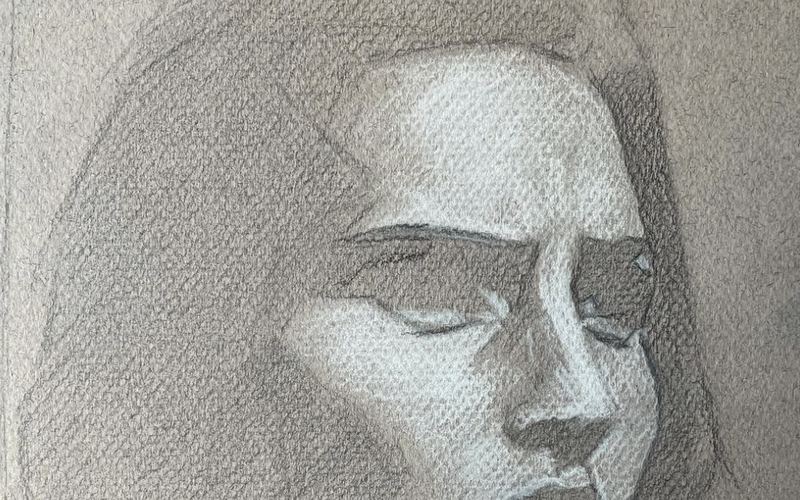
Tuesday evening · at the studio, Paris
Three hours on a single portrait
A weekly in-person session in Paris. Three uninterrupted hours on one portrait: the time it takes to build the head, set the values and carry a study all the way through.
- Day
- Every Tuesday
- Time
- 7 – 10 pm
- Place
- At the studio, Paris
- Group
- 8 people max
- Next session
- the coming Tuesday
- Length
- 3 hours
Sessions run week to week; you join the group as soon as a place opens up.
Who is it for?
No previous experience is needed. The session takes mixed levels: everyone works their own drawing and gets critique pitched to them.
- Complete beginners — foundations rebuilt from zero, for anyone who has never drawn a face
- People living or working in Paris — who want three fixed hours in the week given over to drawing and nothing else
- People who learn better in the room — seeing a hand work at full size changes what you understand about the mark
- People who draw but can’t get a likeness — the problem is rarely in the detail, almost always in the structure
What we work on
The fundamentals of the portrait, revisited in cycles:
-
I
Thinking of the head in three dimensions
Building the head not as an oval but as a volume with planes. That framework lets you construct an accurate portrait from any angle.
-
II
Facial proportion and measuring
The classical relationships between eye, brow, nose, mouth and chin — and the departures particular to each person. The aim is not to apply a template but to read the proportions of the person in front of you.
-
III
The logic of light and shadow
Light area, halftone, core shadow, reflected light, cast shadow: studied on the face, they give a portrait its volume and its presence.
-
IV
The value scale and tonal control
Telling apart the fine transitions in skin, catching needless blacks and weak contrast, holding the legibility of the whole.
-
V
Likeness and a critical eye
Looking at your own drawing analytically and catching proportion errors, angle drift and the small details that break a likeness.
Three hours at a stretch changes the nature of the work: you get past the sketch and into modelling, which a short session never allows.
How does a session go?
- The week’s subject and its difficulty are set out, with a drawn demonstration in front of you
- You work at your easel, undisturbed, for the bulk of the session
- I come round individually, in front of your drawing, while you work
- The session closes with everyone looking at the work together — that’s where the eye improves fastest