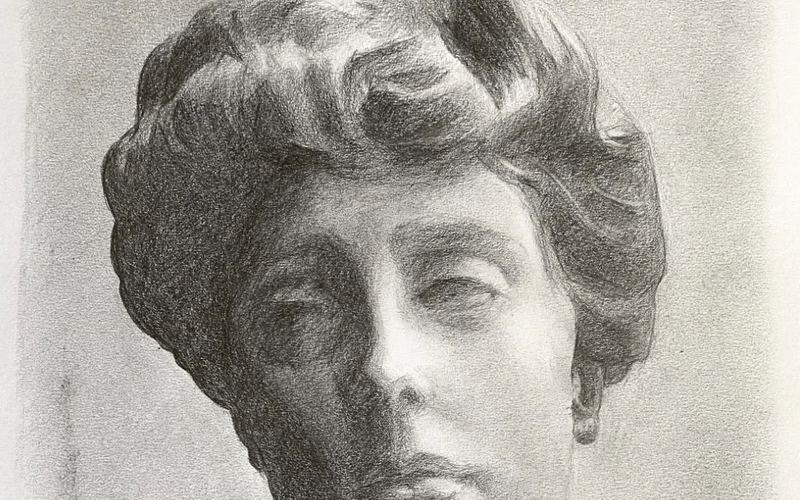
Wednesday evening · online
Drawing starts with learning to see
A live group, every Wednesday evening, wherever you are. Using the methods of the classical realist tradition, we work step by step on measurement, building the form, and reading the light.
- Day
- Every Wednesday
- Time
- 7 – 9 pm (Paris)
- Format
- Live on Google Meet
- Group
- 8 people max
- Next session
- the coming Wednesday
- Length
- 2 hours
The class runs continuously — you join the group at whichever session suits you.
Who is it for?
No previous experience is needed. The sessions move flexibly, so each student gets exercises and critique pitched at their own level.
- Complete beginners — foundations rebuilt from zero, for anyone who has never drawn and doesn’t know where to start
- People coming back — a steady way back in, for anyone who used to draw and hasn’t picked up a pencil in years
- People stuck working alone — the problem is rarely how much you practise, almost always the method
- People who aren’t in Paris — the same method as the studio, from your own table
The programme
What we work on together:
-
I
Thinking of form in three dimensions
Rather than reducing drawing to an outline, we work to understand the volume and structure of objects. Through simple forms — sphere, cylinder, cube — we study how an object is built in three dimensions, how surfaces turn in space, and how light reveals the form.
-
II
Proportion and measuring
An accurate drawing rests on good measurement. Height-to-width relationships, angle control, comparative measurement and the use of negative space: all of them ways to set proportion consciously instead of guessing it.
-
III
The logic of light and shadow
Understanding what light does to form is what gives a drawing depth. By studying the light area, halftone, core shadow, reflected light and cast shadow, we make the volume of an object read far more clearly.
-
IV
The value scale and tonal control
Light-and-dark relationships decide the atmosphere and the legibility of a drawing. We learn to tell values apart and to build transitions under control.
-
V
Observing, and catching your own mistakes
Drawing well isn’t only skill of hand, it’s accuracy of eye. You learn to look at your own drawing analytically and to catch proportion errors, angle drift, value imbalance and problems of form early.
The work moves in cycles. The same fundamentals come round again, applied to different subjects — still life, cast, portrait from photograph. Beginners lay the foundations while more advanced students go deeper, in the same group.
How does a session go?
- The week’s subject is introduced, then I draw the same problem live in front of you
- You work the exercise at your own table
- You get individual critique, on your own drawing
- By following everyone else’s critiques too, you build a more conscious eye